


Over the last couple of years, livestreaming has become all the more important as a creator economy medium. Political streamers are on the news and in the news. TBPN was founded two years ago, then sold to OpenAI in a reported nine-figure deal this spring.
Taylor Craig, today’s guest, is a former television producer now helping knowledge creators (with experience-based authority on a topic) stand up their own streaming shows through his company, Launch Live Now.
In this episode:
— Francis Zierer, Lead Editor
YouTube's reach, your channel, faster growth

Every single YouTube channel should also have an Open.Video channel that they own. Open.Video provides the ownership, direct export access to subscriber lists, and all benefits that come with owning your channel. Take away some of YouTube's control of your channel and sync it instantly to immediately have a channel custom to your goals.
From then on, it's automatic: publish to YouTube exactly the way you do today, and the same video appears at your address, on your player, under your brand.
Then change one habit. Put the URL you own in the bio, the newsletter, the pinned comment, the media kit — and let YouTube keep doing what it's unbeatable at: reach.
One-click YouTube auto-sync — new uploads mirror to your domain on their own.
MRSS and direct upload — .MP4, .MOV, and .MKV land wherever a feed or a file does.
Nothing locked — keep your YouTube channel; Open.Video is additive.
Get started at Open.Video in less than 10 minutes.
This is an advertisement.


Nichecasting
“A YouTube view compared to a livestream view is not even apples and oranges. It's like apples and steak. It is the most engaged viewer imaginable.”
Livestream audiences boast some of the most favorable size-to-value ratios in the creator economy. Why?
Taylor Craig, a former live television line producer now running a business producing live shows for creators, puts it down to a mix of interactivity and niche authority.
In the years before he decided to go into nichecasting, Taylor remembers “all this doom and gloom [he'd] hear in the control room” about the death of TV, which he was always skeptical about because of the sheer volume of content audiences consume today.
Increasingly, Taylor noticed that social platforms were focusing on livestream features:
“They're pushing these livestreams because the platforms themselves understand that the live viewer is so valuable. So they're pushing that, and that retains audience engagement. It keeps people on the app for longer. So naturally, the financial incentives are there for the apps.”
What is nichecasting? Creators streaming hyperfocused business shows for small but valuable insider audiences.
In terms of audience value, size, especially in business niches, is secondary to makeup; advertisers would rather reach 10 likely buyers than 1,000 irrelevant viewers.
When the weekdaily tech business show TBPN sold to OpenAI for an undisclosed price this spring (estimated at around $200 million), commentators noted its relatively small audience — Forbes pegged it at around 70,000 average per-episode views.
The TBPN sale was announced on April 2, 2026. One month earlier, The Hollywood Reporter published Andrew Zucker’s definitive article on nichecasting. He notes that broadcast TV morning shows have about half the viewership they had 15 years ago, and these creators are filling the gap in part.
“Many of these productions function as modern-day trade magazines. One show targets car dealership owners. Another, TBPN (Technology Business Programming Network), focuses on tech overlords. And on March 8, Tinseltown is getting its own SportsCenter.”
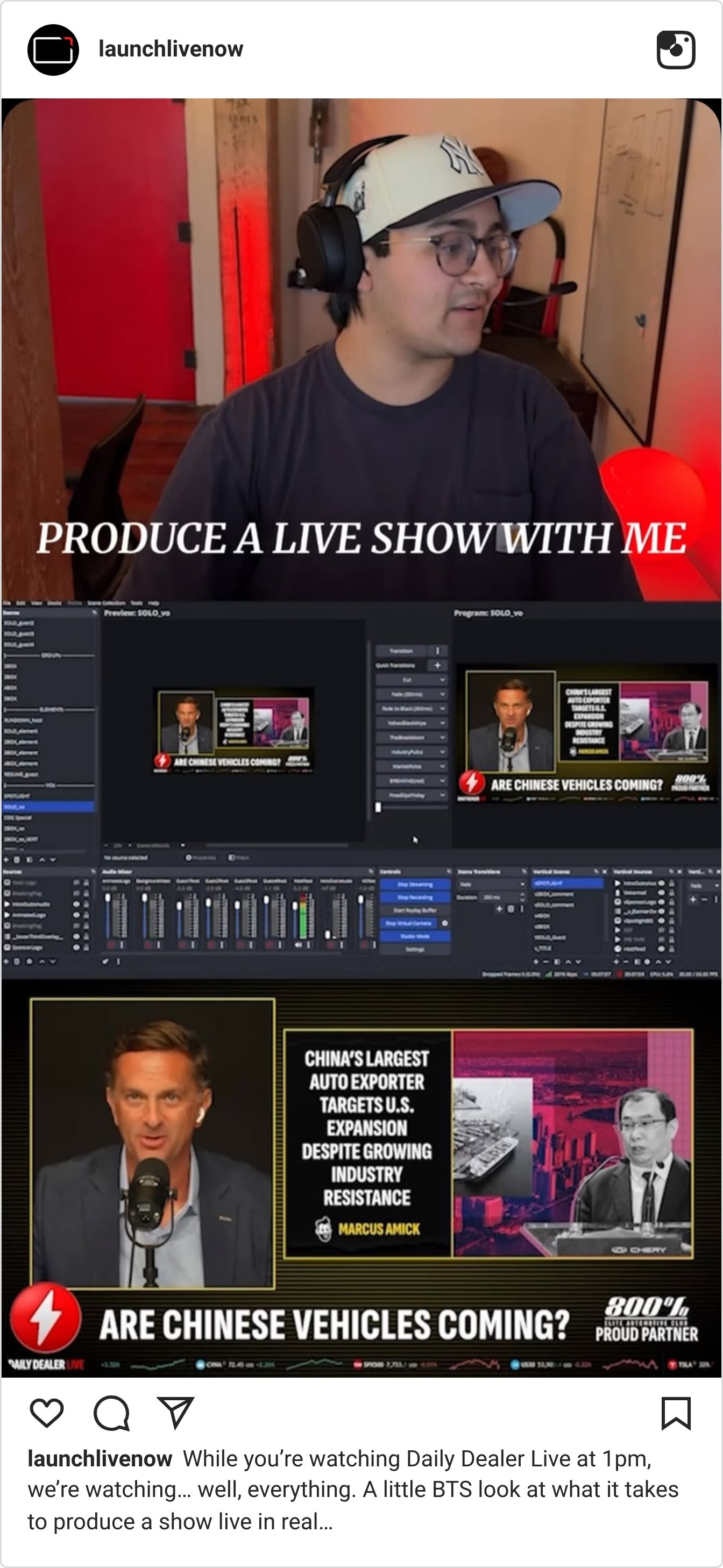
Taylor and his team at Launch Live Now produce that car dealership show, one of eight shows in their roster at the time of our conversation earlier this summer.

Taking broadcast television skills to the creator economy
Like many of the people we’ve featured in Creator Spotlight, Taylor started his business with severance money. He’d been working as a line producer at CNBC for a year and a half when the show he worked on, Last Call, got canceled.
Taylor went to his roommate, Daniel Mesko, a software engineer by trade who streamed flight simulator sessions on Twitch, and pitched a political show called Common Threads; their model was born.
Today, they combine traditional broadcasting production techniques with internet streaming infrastructure to produce niche, business-focused creator livestreams for a slate of clients.

Screengrab from CNBC’s Last Call, the show Taylor produced before founding Launch Live Now.
What does a line producer do? “They are in charge of every single pixel on screen,” as Taylor sums it. It takes many people to run a live television show; a line producer is the connective tissue between them all.
“It's sort of like being an air traffic controller. There are so many different moving parts — audio, transmission, charts, visuals, video, guest feeds — that you're essentially the quality check on all of that, making sure that when something goes to air, it's what we want to see. And you make mistakes. That’s how it works. Like you will never leave a show and you're like, ‘Dang, I nailed that.’”
Before CNBC, Taylor spent four years as a producer at Cheddar, with three years of experience before that across FOX Business and a local station in his previous home of Miami (he’s been working in New York City since 2017).
All of this experience is valuable to Launch Live Now’s creator clients, who may have never worked in traditional media themselves.
Under $1,000 per episode
What defines a good-fit client for Launch Live Now? They’re already bought in on the nichecasting thesis, of course. They’re typically “knowledge creators” as opposed to “typical influencers” — “people that have an authority on a topic and want to connect more with their audience,” Taylor says.
“The biggest measurement and the biggest sale to advertisers is authority, having one particular industry and saying, ‘I own this.’ Like, if people want to come on and talk about this industry, they're going to have to go through us. They're going to talk to us, and that's what TBPN did so well with tech.”
Clients typically come in with “tens of thousands” of followers across a few different platforms; Taylor acknowledges that starting from zero audience with a live stream is difficult.
Their client roster, as of late July 2026, had a total following of 2.94 million. Current shows include:
The Big Skinny with Lou Basenese (business, tech)
The J.D. Durkin Show (finance, the only independent show going live at the New York Stock Exchange)
Fixed Ops Focus (auto industry)
Daily Dealer Live (automotive and dealership trends)
Letterland Live (newsletter industry)
The Shortcut Live (consumer technology)
Investopedia Express Live (finance)
All of these shows are live once weekly except for Daily Dealer Live, which goes live every Monday, Wednesday, and Friday.

Taylor appearing on an episode of Letterland Live this July.
By the time I interviewed Taylor for our podcast this July, he and his team had produced 538 live episodes across their show roster over nearly two years in business.
Taylor did not provide specific revenue figures, but he did share the cost of their core products. When I did the basic math to arrive at just over half a million total revenue since the business’ founding two years ago, he affirmed the estimate.
The initial show buildout is priced at just under $5k
Each episode is priced below $1k (each one is about an hour long)
Taylor says there is typically a 1.5–2 month period between when a client comes in and when their first episode goes live.
Buildout sees the Launch Live Now team helping with everything from the show’s look to specific segments to the core concept — working with the hosts to determine how best to highlight their specific skillsets.
Each episode takes place over a three-and-a-half-hour window. For that $1k-per-episode price, clients have two producers running each episode. There is a two-hour prep period before each episode goes live:
“We tell all of our hosts, have your rundown ready. Tell me the stories you want to talk about, the tweets, the videos, the stock charts that you want to see. Let's do it all. Have that in two hours prior to the show.”
Half an hour after a live episode wraps, Taylor’s team has it published as an on-demand podcast.
With a staff of four producers besides Taylor and his co-founder Daniel, they can run three shows per day. When we spoke, they were onboarding two more producers to increase capacity. At the beginning, it was just the two co-founders. One year after founding the business, they’d doubled to four; two years in, they’re doubling again.
Clients pay per quarter, ensuring stable revenue. Taylor described five revenue pillars, only two of which are currently active:
The existing two revenue pillars are:
Production costs (standup and recurring episode fees)
Social clipping (and other production or post-production add-ons)
The three unbuilt revenue pillars are:
Distribution as a service
Ad sales as a service
Software as a service — Taylor’s co-founder Dan has built custom tooling for the company and plans to build more; they may license it to streamers who don’t need the company’s full suite of production services
One area Taylor says they will not venture into is building their own shows; they are “dead focused on being a plug-and-play live solution.” So far, he says, they have no competitors offering exactly their services — just “a lot of clients” telling them Launch Live Now is “exactly what we were looking for.”
We are, as Taylor put it to me, “ so early in the game when it comes to livestreaming and nichecasting.”

Learn more about Launch Live Now on their website.
Connect with Taylor on LinkedIn.

Should you make a live show?
If you already have a loyal audience of at least tens of thousands and a strong desire to work in the format long enough to build momentum … maybe.
If you already make a video podcast, maybe; there’s a logical format translation. But not every video podcast with a loyal audience needs a livestream. What defines the ones who should try making a live show? A desire for community.
When you can create a room where people want to talk to each other and can talk to the hosts, Taylor says, community blooms.
What questions should you ask to sharpen a show concept?
I asked Taylor what questions he’s asking of new clients to solidify their ideas and determine how they might work together. He’d approached Investopedia, the 27-year-old financial internet media business, who were looking to evolve their existing podcast, The Investopedia Express.
Below, I’ve paraphrased some of the questions Taylor remembers asking during that process, as well as some more general questions to be asked of any such show:
Do you want each episode to focus on one big headline, or a variety of issues?
If you focus on one big headline, bring in a guest expert every time.
If you focus on one big headline every time, with a consistent guest block, you should make this a named segment.
With Investopedia, the host likes to skateboard; Taylor pitched calling the segment “The Drop In,” and making an animation of the host on a skateboard to brand the segment.
Investopedia focuses on educating investors, and the show airs at 10 in the morning every Monday; you need a segment dedicated to preparing the audience for the calendar week — “who's reporting earnings, what are the big economic reports coming out?”
How many guests do you want per episode?
How much news comes out, and how often, in your industry? Is there enough where you can fill a consistent segment covering five or six different headlines each week?
What is the host’s skill set? How can we play to it?
How do you measure a livestream audience for advertising partners?
Livestream view counts are typically lower than view counts for similar on-demand videos; assess these numbers with that in mind. Here are the metrics Taylor says are most important:
Views on social clips made from the show
How active the chat is
How active the comment sections on the clips are
Who is engaging in the chat and comment sections
Are the people in the comments and chat talking to each other, or just back and forth with the host?
