


In just 3.5 years of newslettering, Rowan Cheung has built an eight-figure business with around two dozen employees. He gained enough clout in his industry — tracking developments in AI — to land interviews with names like Mark Zuckerberg and Sam Altman. This summer, he took on investment to expand into video.
In this episode:
— Natalia Pérez-González, Assistant Editor
Introducing the most emotive voice model ever

From the emotion in a single line to the voice that carries a whole story, ElevenLabs’ latest voice models Eleven v4 give creators more control over how their work sounds. The result is audio that feels performed, with way more ways to make it your own.
Now you can add direction for pacing, delivery, and reactions right in your script. Clone your voice from just 10 seconds of audio, keep it consistent across longer projects, and create for audiences in 90+ languages. That could mean a narrated newsletter, a character driven video, or an audiobook ready to find global listeners far beyond your usual reach.
Eleven v4 is available now. Until October 12, Creator plans and above in ElevenCreative can use it for free, up to twice their monthly credits.
This is an advertisement.


Profitable since day one
By the time ChatGPT launched in late 2022, Rowan Cheung had been obsessively posting about AI developments to his roughly 1,000 Twitter followers for almost a year.
In the wake of that launch, demand for the type of content Rowan was making skyrocketed.
While others covering the AI space were publishing just one big thread every Sunday, Rowan committed to posting threads twice a day. He also launched a newsletter for more in-depth coverage, The Rundown, which he’d promote at the end of every thread: “Keep up with AI in five minutes a day… you don't actually have to be on Twitter all day."
Rowan launched The Rundown in January 2023. By May, he’d built a list of 150,000 subscribers. (We featured him in the Spotlight for his work at the time.)
The newsletter was profitable almost immediately, as Rowan used SparkLoop, a platform that pays newsletters to send new subscribers to other publications (similar to beehiiv’s paid recommendations system). As his audience grew, those recommendations brought in $30,000 to $40,000 a month, enough to fund his first two hires — a salesperson and a writer — roughly four months after launch.
The advertising arm of the business was scrappy at first.
Sponsors booked placements through a paid Calendly link, essentially reserving an ad slot as though they were scheduling a meeting. Each placement cost $300 (a price Rowan now considers absurdly low), with links often receiving between 2,000 and 3,000 clicks.
By the end of that first summer, audience growth slowed. X had begun suppressing posts containing links, Rowan recalls, and competing AI newsletters were proliferating. Around the time The Rundown surpassed 250,000 subscribers, he started pouring profits into Meta ads and developing a signup funnel designed to recover part of that spending immediately.
Meta ads were bringing in qualified subscribers for around $1.50 apiece, while referral fees and personalized offers in The Rundown's signup funnel helped offset those costs.
At one point, Rowan says, the company came close to earning back the cost of each subscriber before they’d even received their first newsletter.

An eight-figure newsletter
Today, three-and-a-half years after launching The Rundown off the back of his tweets, Rowan has built an eight-figure media business with 23 full-time employees and more than 3 million subscribers across three newsletters.
The flagship AI-developments newsletter alone reaches 2 million subscribers, with an open rate Rowan told us stays above 55%. With just two full-time salespeople, The Rundown has sold out ad slots in its daily newsletter for three consecutive years, relying entirely on inbound inquiries and repeat advertisers. Rates increase every quarter.
The Rundown now consists of:
Three newsletters (covering AI, technology, and robotics)
An active social presence:
Instagram: 629k followers
X / Twitter: 229.4k followers
LinkedIn: 26k followers
Interviews on YouTube (199k subscribers)
An AI education business, Rundown University
The company has been profitable since day one.
This summer, however, The Rundown took its first outside investment from Electrify, a firm specializing in scaling creator businesses whose portfolio includes major YouTube brands like Veritasium and Fireship. The company had approached Rowan before, but he wasn’t ready for investment at the time.
Why take investment now?
The deal gave Rowan some personal liquidity while allowing him to remain CEO and retain operational control. For Rowan, the biggest draw was Electrify's experience building and scaling video businesses; he’d experimented with video in the past, but felt it was time to go all-in. Electrify's board also includes former Duolingo executives whose expertise could help Rowan expand Rundown University, the company's AI education business, into an app.
Like many creator-founders in the newsletter space, Rowan points to Morning Brew as his model, for the way their newsletter evolved into a media company with a slate of newsletters and video shows.
"I think newsletters are amazing, and I'm grateful it's the first place we started," he tells us, but he believes adding long-form video will make the business more durable over time.
His foray into video
Rowan’s foray into video is a notable reversal for someone who once avoided being on camera altogether.
Early on, his team created an AI avatar of him — complete with a cloned voice — to make short-form videos based on scripts adapted from the newsletter. They were open about the fact that this was an experiment using AI, and audiences responded well. Coming from a creator and business obsessed with AI, it worked. This wasn’t a lazy one-shot project, either; their director of media still spent two to four hours a day scripting, editing, and publishing the videos.
Rowan had considered becoming a YouTuber before launching The Rundown. But he trusted his writing more than his camera skills and worried that spending months learning video would cost him the opportunity quickly unfolding around AI.
@rowancheung 🦟🚫 Tornyol, a San Francisco–based startup founded by two French engineers and backed by Y Combinator, has built a tiny drone that hunts mo... See more
Rowan’s AI avatar grew his Instagram following to beyond 200,000 followers, but as the account began attracting sponsors, he questioned whether an AI-generated version of himself could build the audience relationships he wanted long term.
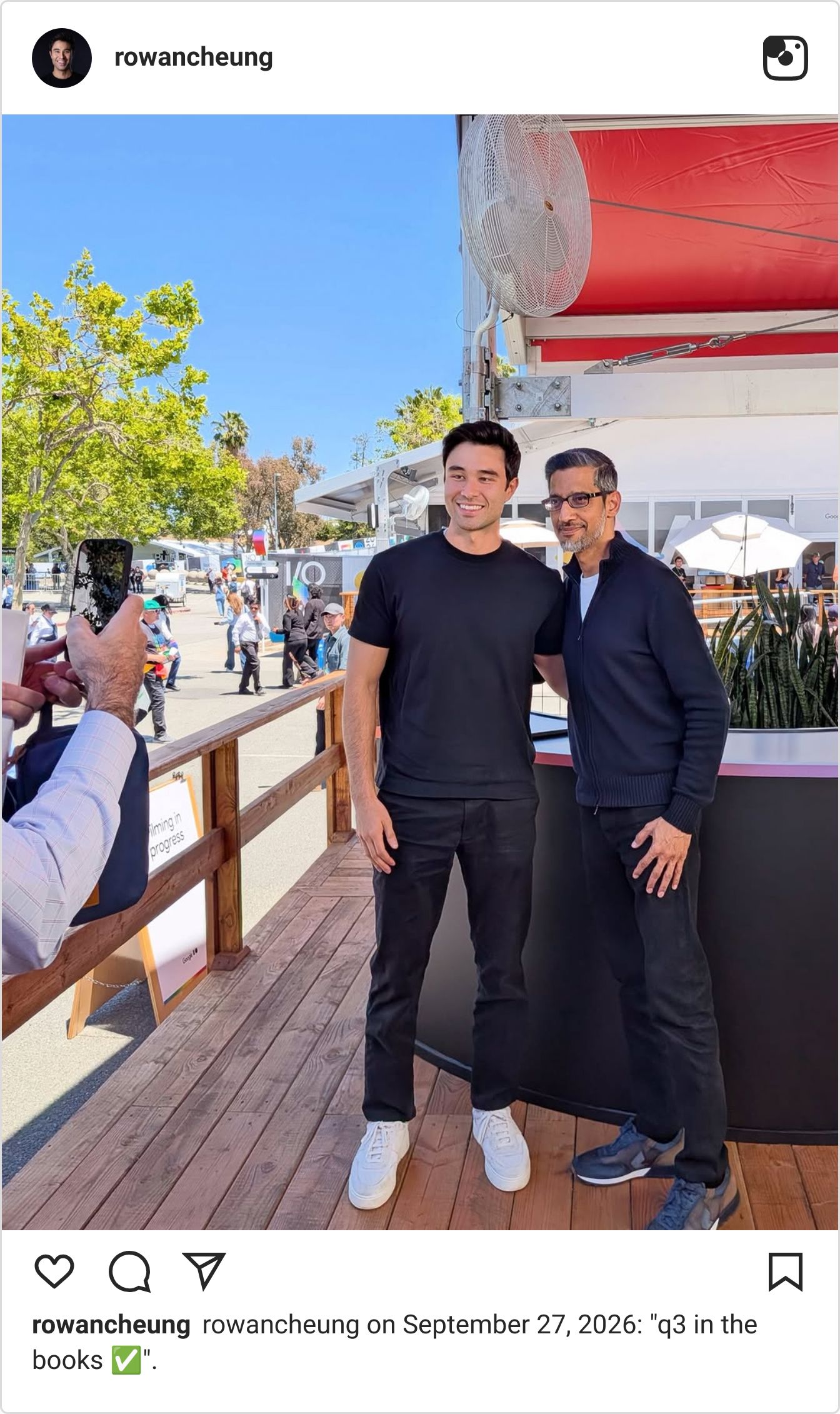
He was also becoming an interviewer. His first on-camera appearance of any kind was a sit-down with Mark Zuckerberg. Major AI-world names like Sam Altman, Satya Nadella, and Sundar Pichai are among his other guests. As he grew more comfortable in front of the camera, it made less and less sense to keep using an avatar for short-form.
Meanwhile, people meeting Rowan in person, who’d seen his avatar videos, kept making jokes that they weren’t sure if he was a real person, that they were glad to see he was.
So, around the end of 2025, Rowan began filming the videos himself.
Today, his personal social accounts have a combined following of roughly 1.4 million, with Instagram being his strongest platform for engagement. On YouTube, The Rundown AI has approximately 199,000 subscribers and 47.6 million lifetime views.
A substantial audience, but still much smaller than The Rundown's email readership. And while its interviews with some of Silicon Valley's biggest names have attracted significant attention, building a roster of repeatable shows is a different challenge from securing marquee guests. This is where the Electrify team will offer the most help.
Rowan wouldn’t share much about what's in development, beyond plans for multiple long-form shows, but his direction is clear: as AI makes producing and distributing content easier, he believes the relationships and personalities behind that content will become increasingly important.
"If you're doing something the AI can replace one day, there's not really a moat," he says.
Subscribe to The Rundown.
Connect with Rowan on LinkedIn, Twitter, and Instagram.

A few notes on cashing in on growth at the right time ✍️
“Go all out on something that works, because it’s not going to work forever.”
Rowan admits that much of The Rundown’s success comes down to "right time, right place": his viral ChatGPT threads, Twitter's then-better organic reach, his early adoption of SparkLoop.
He even attributes the success of his advertising business partly to timing luck, having built a popular, visible AI publication just as companies were scrambling to reach people interested in the technology.
And he’s right — several of these conditions no longer stand. X no longer rewards links and threads like it did in early 2023, competition for AI-interested newsletter subscribers on Meta is more fierce, and the early AI newsletter boom produced plenty of competitors who had access to the same opportunities but didn't achieve his scale.
What distinguished Rowan wasn't his ability to predict what would take off, but how quickly he moved once he found something that worked:
When a ChatGPT thread went viral, he didn't experiment with five new content formats, but instead increased his output to two threads a day in the same format, each funneling readers into his newsletter.
When SparkLoop began generating $40k a month, he used that money to hire a writer and a salesperson, giving the business more capacity to produce and monetize what was already working.
When his Meta ads brought in qualified subscribers for around $1.50 apiece, he scaled spending and developed a signup funnel to recover acquisition costs faster.
Each opportunity funded the next, turning advantages that might disappear overnight into assets he could keep: an email list, a team, a revenue-generating acquisition system, and eventually an education business built around the same audience.
When asked how to recognize a winning growth channel, Rowan's answer is essentially that you'll know. Not every creator has the capital to dramatically increase ad spending, or the good fortune of entering an industry at precisely the right moment, but there's still a practical way to apply his thinking.
Start by identifying what's demonstrably working. Look for a repeatable result, whether that's a content format consistently converting viewers into subscribers, an acquisition channel delivering engaged readers at a sustainable cost, or a product that keeps customers coming back. Then test whether increasing your investment produces comparable returns. If it does, consider directing more resources there.
Audit the projects competing for limited resources. When you’re growing, be vigilant about opportunity cost. Rowan killed two profitable products — an AI tool database and a job board — because he knew his time would be better spent on the (more important) newsletter and education products in the long term.
