

Brought to you by beehiiv.

Social media audiences love food content more than any other category. They also love game show concepts, especially when there’s an element of audience participation.
Rob Martinez and Julian Mu have found a clever, cross-platform way to combine all it all.
In this episode:
— Natalia Pérez-González, Assistant Editor
You've been "about to build it" for 3 months

Your idea has been sitting in a Notion doc for three months. The dev quote was six grand. The freelancer ghosted. Sound familiar?
Bolt.new is where you finally ship it. Type what you want to build, and it builds the real thing — actual code, hosted on a real domain, ready for users. No platform lock-in. No team of engineers.
Indie founders are launching landing pages, member portals, and lightweight SaaS tools in an afternoon.
Stop waiting on someone else to build your idea.
This is an advertisement.


Food content as an audience-driven game show
Food and lifestyle content, according to a 2025 Deloitte study, is the most-followed topic on social media. And restaurants rely on creators for marketing: 46% of respondents in that study said that “working with creators” was their second-highest returning strategy — even though it was their lowest-priority social tactic.
Some of these creators demand fees from restaurants; I have 100,000 followers, for a fee, or at the very least a free meal, I will make a video about your restaurant.
Rob Martinez and Julian Mu are not these creators.
Rob estimates his total spend on food, hotels, and flights to produce his videos last year at around $90,000. No investors footed the bill; there’s no studio, no manager, no agent, just Rob funding his own channels out of pocket.
While Rob previously worked as a producer for another food media company, he’s been fully independent for around two years. Julian, who was previously a tech industry product manager, has been working as a full-time creator just about as long.
Both men have built large audiences for their earnest and honest short-form videos.
Rob is best known for journalistic stories about the people behind often less social-media-famous restaurants; as his YouTube bio reads, “I tell stories about people and food”. His total following is currently 1.59 million:
Julian’s content stands out for his skill as a series producer; Foodie Faceoff, for example, is a bracket-style competition in which his network of food-world connections recommends dishes for him to try and judge against each other. His total following is currently 631.8k:

Pairs well with …
Rob and Julian first met a few years ago while out to eat with mutual friends and immediately began discussing ways to collaborate. They bonded over a shared integrity in how they approach this work — as Rob put it:
“In this kind of creator world, a lot of folks don't choose where they go. Not to be vague about it, but you know, there's a lot of invitations, there's a lot of pay for play. Julian always has chosen where he wants to go, or he's always found a creative way to get a great recommendation from somebody that you want to hear from.”
After batting ideas back and forth, they launched Feasting on $50 in October 2024. Though their combined following is over 2 million, the duo decided to start fresh channels. The current total following is a relatively modest 52.2k:
Notably, while both are known as short-form creators, their work together is long-form and lives on YouTube (both have experimented with long-form on YouTube in the past, but their following comes from YouTube Shorts).
Feasting on $50 plays out like this:
The duo pick a city (past locations include Brooklyn, New Orleans, and Philadelphia)
They are each given a food budget of $50
Within that budget, they must buy breakfast, lunch, and dinner
They start the day together, then head out to find breakfast
They post a picture of every meal to the Martinez & Mu Instagram account, describing it and running a poll for their followers to vote on which meal looks better and should win the meal
With three polls in a day, each broken down by percentage, there are 300 points available
After breakfast and again after lunch, the duo call each other to pick “daily specials” — like power-ups in Mario Kart, as they describe it. Each picks one to apply to their competitor (such as restricting phone usage, requiring the next meal to be pescatarian, or requiring the next meal to be within a 1-mile radius of current location)
At the end of the day, they tally up the points and determine the winner
The audience doesn’t know who won the day until the full video hits YouTube weeks later.
The friction between their instincts in picking meals — and the chemistry between their personalities — is what makes the show. Julian has a knack for picking Instagram-pleasing plates (he’s still won more cities across the series), while Rob often chases locations with history and stories he can tell about a place.
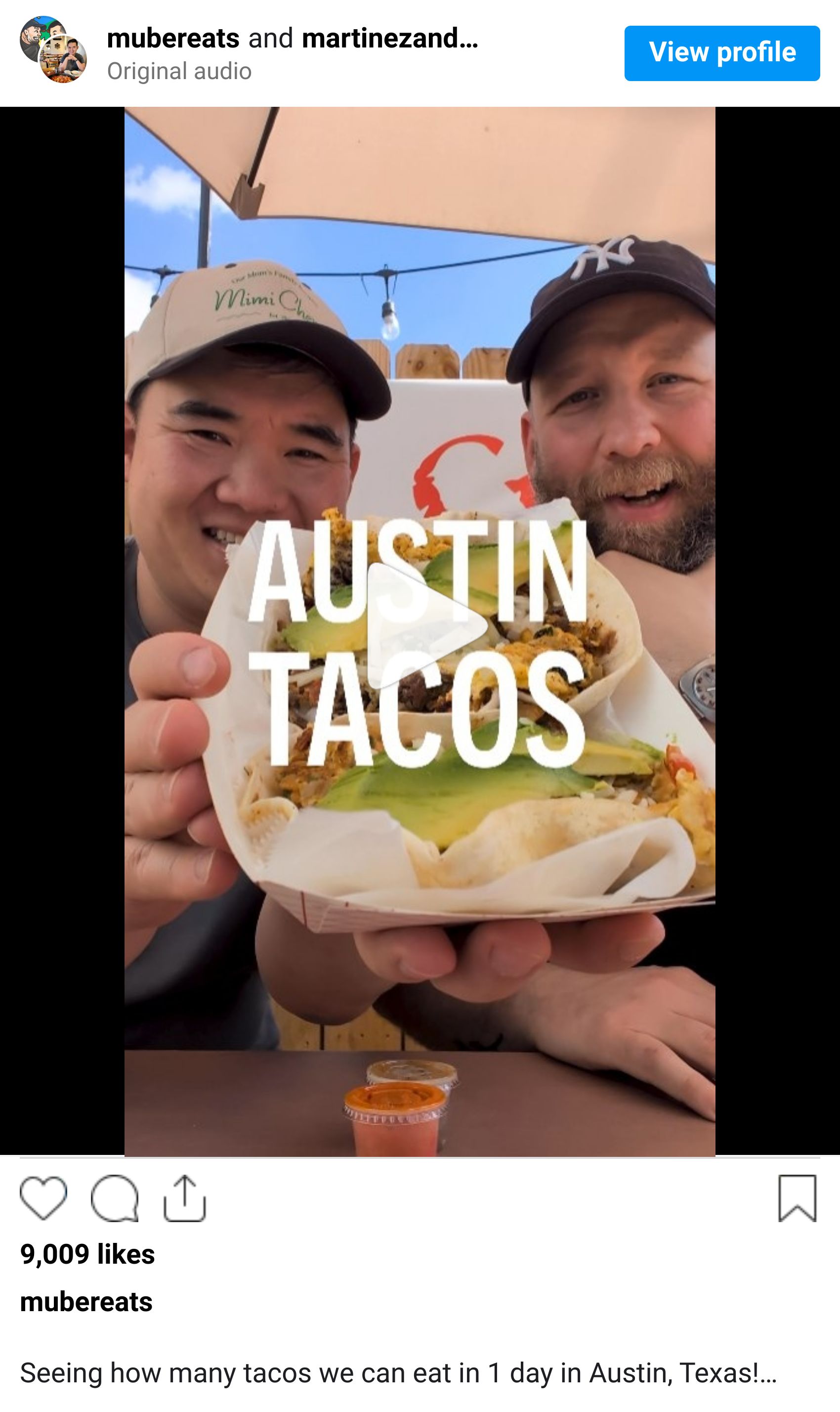
In Austin, for example, Julian grabbed a $10 brisket breakfast burrito from a spot that opened in late 2025. Rob went to Joe's Bakery — serving since 1962 — knowing full well he'd lose the round, and went anyway, because that's the kind of place he'd put on his own channel. They share the same foundational values on food, but opposite tastes. That's the engine, and they name it out loud on camera.
Each episode of Feasting on 50 costs $3,000 to $4,000 to produce. The money comes mostly from brand partnerships — Meta, Chime, Resy — with platform payouts filling in the gaps.
The show works best when each video bends toward its location, so in season two, the “daily specials” were built around each city; in Boston, an Independence Day round limited them to cuisines from countries that broke away from England.
The format itself is in flux, too: they mention a potential Taipei episode shot entirely at night, instead of breakfast-to-dinner, to focus on local night markets. Every new wrinkle has to clear one bar — does it make the show more like Martinez & Mu, or less?
Originally, the duo planned to do six-episode seasons, each with a different series concept. Besides Feasting on $50, they had another idea called Food Duels. They published two episodes — one about finding the best sandwich in NYC, the other about finding the best sausage in Chicago.
@martinezandmu Season 2 of Martinez & Mu is here, and we're having a premiere! It will be next Tuesday, 10/28, in Soho. Tickets are $5 and you can buy th... See more
These are the two least-viewed videos on their channel. And the comments didn’t show as much enthusiasm as for Feasting on $50. As Rob put it, the show misunderstood long-form YouTube; remember, they were used to short-form.
The failed concept didn’t work on YouTube because it was too active all the time. With the winning concept, there’s plenty of downtime between meals, footage of the two going on “side quests” and telling stories.
“When we watched Food Duels with an audience, it was like — this is awesome. People were watching it on a big screen and getting into it, and they understood all the rules and all of the nuance.
But when people are just having it on [watching alone], and maybe they step out for a second to go like, put their lunch in the bin or whatever they're doing, they were missing key things about the game.”
In New Orleans, after spending days filming Food Duels, Rob says he crashed out. The show wasn’t working; he didn't feel he was creating something authentic to himself. The duo called his fiancée to tell her they were binning days worth of Food Duels footage and coming home.
“She was on speaker, and she goes, ‘You guys have a full day tomorrow, why don't you just shoot a full day of Feasting on 50? As she said that, we did that, like, dramatic movie turn to each other and we're just like — yeah, that's actually such a good idea.”
The latest season of Feasting on $50, a West Coast tour, launches with a Portland, Oregon episode this Thursday, May 28.
Subscribe to their YouTube channel to catch the episode.
And to vote in the next season, follow Martinez & Mu on Instagram.

A few notes on formats and partnerships
From your Assistant Editor, Natalia Pérez-González — a couple of ideas that stuck with me as I listened through this week’s conversation ✍️.
The type of food video audiences might watch on their phone during a lunch break — the genre Anthony Bourdain built, really — is a crowded arena, pitting Martinez & Mu against the likes of Phil Rosenthal, Matty Matheson, and Action Bronson for the same set of eyeballs.
The difference is that those names have studios, staff, and studio budgets behind them; for Martinez & Mu, independence is the doctrine.
They have no second unit, no producer beyond themselves — both have been pitched by managers and walked away.
Their differing skillsets and perspectives strengthen the show:
Rob is the journalist. Through his series Eating With Robert, he scouts and shoots the kinds of places critics like Jonathan Gold, Ligaya Mishan, and Robert Sietsema built careers writing about — the corner pizzeria, the Egyptian fish grill, the Turkish kebab counter. He's drawn to the room, the owner, the story.
Julian is the series builder; Feasting on $50 grew out of his earlier short-form franchises, Dining on a Dozen and Feeding on $15. He thinks in formats, hooks, and titles.
The premise of the game is thoughtful and smart, a food-themed game show.
A vlog of two guys eating would be fine, but the tension here is what makes it sing: the $50 budget cap, the head-to-head Instagram vote, the surprise "daily specials" they spring on each other mid-shoot (a peanut allergy, a one-mile radius, only cuisines from countries that broke from England).
Every rule adds a layer of tension and a reason to keep watching — where will he go now, with $20 left and this curveball? and generates genuine stakes without a script.
