


Nine years ago, Jack Settleman started a sports highlights account on Snapchat. By 2021, he’d quit his job to work in Snapback Sports full time. Today, the business has 15 employees and brings in seven-figure annual revenue with around a 20% profit margin.
In this episode:
In this episode:
— Francis Zierer, Lead Editor
What does the onset of AI audio mean for creators?

AI can now dub a video into another language, turn text into lifelike audio, and help a single idea travel from Anaheim to Azerbaijan. But the interesting question isn’t just what the technology can do. It’s what audiences actually want from it.
On Tuesday, October 6 in NYC, Creator Spotlight and ElevenLabs are bringing newsletter growth expert Nathan May, YouTuber and creative strategist Dara Denney, and Ryan Bast from ElevenLabs’ Creators team together for an IRL discussion we’re calling The New Reach: How Creators are Growing with AI Tooling.
We’ll get detailed about what’s working, what’s capturing people’s attention, and what creators need to know to get the most out of this new tech.
Space is limited, but I know this is a conversation that could truly help you reach new (and global) audiences. Hope to see you there.
This is an advertisement.


A creator’s equity bet pays off
Snapback Sports, Jack Settleman’s solo-creator business turned media company, surpassed $2 million in revenue in 2025. Even with double-digit employees and an office space in New York City, it was profitable — granted, Jack did not take a salary.
In 2021, when Snapback was still just Jack, and he started working for himself full-time, he signed a deal with Underdog Sports, a sports prediction and fantasy business founded in 2020, as their first creator partner.
The deal, Jack says, was for around $130k cash and $120k in equity, with Underdog then valued at $50 million.
This summer, Underdog sold for $1.3 billion. With the company having raised multiple rounds since Jack signed that deal, his stake was diluted — but still worth between $1 and $2 million, he says.
Would he take the equity bet again? He’s signed two deals with Underdog since — their current deal runs into 2027 — neither of which included equity.
Today, Snapback has 15 employees. Plus, this March, Jack and his wife welcomed their first child. He’s in a necessarily risk-averse period of his life relative to the day he signed that equity deal.
“Don't take the equity. It doesn't work out nine times out of ten.”

Highlights to original content; Snapchat to YouTube
Snapback was born on Snapchat in 2017, early in Jack’s senior year at UT Austin. He was copying House of Highlights, which was, at the time, the top NBA highlights account on Instagram. He saw an opportunity to run their play on Snapchat; it worked.
Over the next few years, Jack watched people like David Dobrik and Livvy Dunne rake in thousands of dollars a week through Snapchat’s revenue-share program. Snapback, being primarily unoriginal content — highlights, memes, and news — was not eligible.
After graduating in 2018 and until 2021, Jack worked full-time jobs in sports media, first in social for the betting-and-analytics-focused The Action Network, then in content and talent for the creator-driven Team Whistle.
All the while, he kept posting on Snapback’s accounts, which today boast a total following of at least 1.524 million:
152k on YouTube
272k on Instagram
897k on Snapchat
27k on X
176.4k on TikTok
Snapback’s breakthrough original content product — still the core of their offering today — was “Snapback Experiences.” Starting in college, whenever Jack went to a sports game (be it college football, his hometown Ravens, or, visiting his now-wife in New York, the Knicks), he’d post pictures and videos of the game-day experience. He’d do this about once every two weeks, and the audience loved it.
“So when we finally got some money in 2021, that's when I went full time, but also started creating original content and started this tour-based kind of model that we still use today.”
This is the core Snapback media offering today: typically 20–30-minute videos of Jack or one of Snapback’s other hosts (sometimes together) spending a day going to a game. At the end, they’ll rate the experience on factors including fans, stadium, food, and uniqueness, giving the overall experience a number that situates it against all other experiences they’ve had (190 as of this writing).

The current top of Snapback’s 190-strong Experiences table.
Sometimes these experiences are one-offs; other times they’re part of a “tour.”
This summer, for example, Jack sent one of his hosts (“The Intern,” also known as his little brother, Casey Settleman) to 33 FIFA Men’s World Cup games in 39 days — he attended a game every single game-day of the tournament, except for the third-place game. (They broke even, by the way — Jack detailed the financials in his newsletter.)
Jack realized early on that he couldn’t be the face of Snapback, that “the only way to build a sustainable business was actually to build a media company, because that's a business, and you're not reliant on a singular person.”
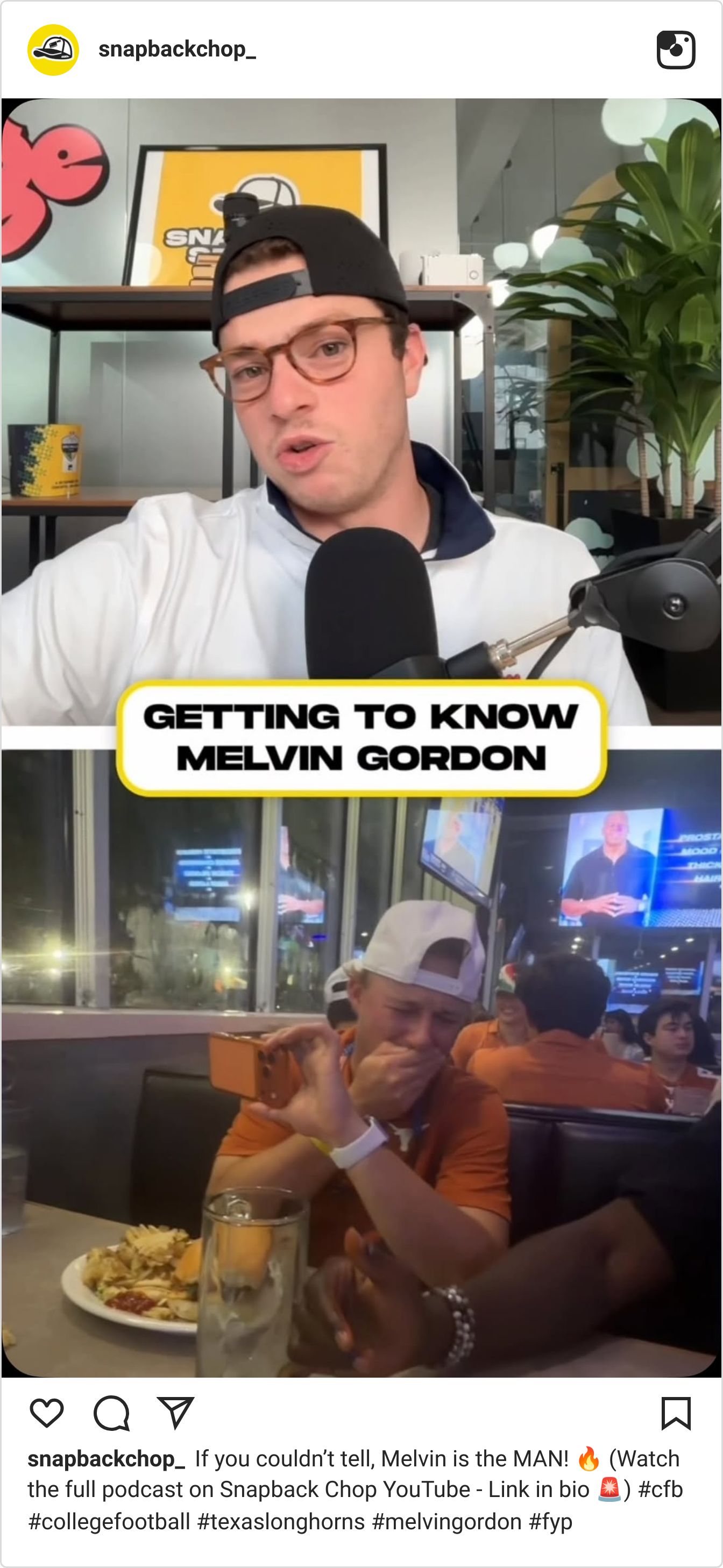
The latest non-Jack face in Snapback content is Melvin Gordon, an esteemed running back in college who went on to play almost a decade in the NFL. He’s joining the team for 15 games during this college football season. Jack believes plays like this will keep their content ahead of the curve in an increasingly saturated market.
A profitable business through advertising
With just over a quarter of 2026 remaining, Jack expects the business to hit $2.5 million in revenue this year. The final count is yet uncertain, but we know exactly how much money the business brought in each of the last two years — Jack is a build-in-public type:
2024 | 2025 | |
|---|---|---|
Revenue | $1,677,722.00 | $2,094,433.03 |
Expenses | $1,354,575.00 | $1,627,642.00 |
Profit | $323,147.00 | $466,791.03 |
The “heavy majority” of Snapback’s revenue is advertising. They sell merch, but it’s “an awareness game as opposed to a monetization game.” Who sells ads for them? Formerly one of Jack’s college buddies, and now Excel Sports, one of the major sports agencies. Evan Williams is the title sponsor for the current football season.
They do not have a paid subscription product, but they are working to monetize direct-to-consumer through apps. They have two in-progress apps, both rooted in successful content franchises:
A kind of “sports Yelp” based on the Experiences concept. Any time Jack or his team head somewhere for a game, they have to figure out where to stay, what to eat, and the traditions of the local sports culture. These details can be found on old Reddit and Twitter threads, but Jack says there’s no centralized, reliable source; Snapback’s app can be that source.
A sports trivia app. Besides Experiences, one of Snapback’s most popular concepts is a trivia show. The productized version will have in-app purchases.
Even as they build out their apps, Jack plans to keep focusing on advertising — their partnerships keep scaling, with no signs of slowdown. He compares the strategy to a professional athlete’s singular focus:
“No one tells a great athlete, don't go and play in the NBA. They're like, no, train every hour because that's the outcome you're looking for.”
Another way of continuing the family business
Jack grew up with a family stake in the game-day experience. His mother ran the business his great-great-grandfather founded, supplying beer to the Baltimore Ravens and Orioles stadiums. And his grandfather was a “big gambler.”
“I think that alcohol and gambling are obviously vices and are viewed in a certain way. But what I learned from [my grandfather] in both the beer business and then in gambling was, you know, bankroll management, unit control.”
None of Jack, his brother, or his cousins went into that family business, which has since been sold. His sense was that the business had reached its cap, with little desire among the stakeholders to expand to new markets; he wanted more.
And he is getting more. Sure, Snapback may not have surpassed the yearly revenue his family’s business brought in supplying stadium-scale volumes of beer quite yet. But, in a major milestone this college football season, they’ve sponsored a college football team — they’re the jersey patch sponsor for the Sam Houston Bearkats.

I asked Jack when he’d take a salary again. If he decides to raise money and cede control over part of the business, then yes. If he stopped seeing the value in re-investing in the business, sure. From what I’ve learned of his personality, I’d say the odds of the former are low and the odds of the latter, absolutely minuscule.
Working with Melvin Gordon, sponsoring the Bearkats — these investments drive him. It’s plays like this he believes will help Snapback hit his 2027 goal of $4 million in revenue.
“Anything that is fun, anything that any kid would go, ‘That's freaking cool,’ I wanna be doing that.”
As I prepared to publish this write-up, I checked Jack’s Twitter. Last night, he put $100 on a 5-bet parlay with +79,328 odds. It was a way to hedge against his fantasy football matchup. He won; the payout was $79,428.16 before taxes.

Subscribe to Jack’s building-in-public newsletter.
Connect with Jack on X.

Delete your account
Snapback’s transition from short-form to long-form content was not an overnight success.
Transitioning from Snapchat and Instagram to YouTube Shorts was a straightforward success; just like on those other platforms, their short-form videos garnered thousands of views. Soon enough, the YouTube account had hundreds of thousands of followers. While their Shorts thrived, their foray into long-form YouTube, even on that same account, didn’t work.
The first long-form video on that account, posted in December 2019, has 2.5k views today.
The latest, posted in November 2023, has 1k views.
The most-viewed, posted in November 2022, has 15k views.
So Jack abandoned the account to start anew, this time focused on long-form over short-form. But what wasn’t working?
The short-form content served a lowest-common-denominator audience while the long-form had niche appeal.
“Our old channel would be, like, Casey and I going to a Thursday night football game in long-form, and then the Shorts were, like, mascots dumping popcorn on fans' heads, right? So it's completely unrelated.”
As a more specific example, Jack and Casey went to the Kentucky Derby, watching from the winning horse’s owner’s suite. Even now, the video only has 2.5k views. It made no sense to them. Even if the content itself wasn’t perfect, wouldn’t anybody searching the Derby on YouTube click this video? They felt they could stand behind it.
They soon stopped posting to that account entirely. Their active account is still far from reaching the old account’s following — 152k subscribers compared to 566k — but the views are there.
The first long-form video on the newer account, posted in November 2023, has 16k views today — more than the most-viewed video on the old account.
The latest, posted in September 2026, has 34k views.
The most-viewed, posted in September 2024, has 515k views.
It’s been said before and will be said again: follower counts are meaningless. Proof of audience-life is in content-side viewcount and engagement. If your content is radically changing, don’t hold onto a dead account for follower count’s sake; start a new one.
