

Brought to you by beehiiv.

There’s been a constant undercurrent of generative AI discourse in the creator economy for years at this point, but the last couple of weeks have been a bit of a boiling point.
So, in that context, I went down the rabbit hole on an Instagram creator openly using generative AI.
— Francis Zierer, Lead Editor
Sync with YouTube in one click. Keep the reach, own your content.

With the Open.Video, you can finally own, host, and customize your channel and keep your YouTube subscribers, export them, and add them automatically to newsletter lists.
Link your YouTube channel and your library lands on your domain — most creators activate in under 10 minutes, and a full back catalog is typically live in under an hour. From then on it's automatic: publish to YouTube exactly the way you do today, and the same video appears at your address, on your player, under your brand.
Then change one habit. Put the URL you own in the bio, the newsletter, the pinned comment, the media kit — and let YouTube keep doing what it's unbeatable at: reach.
One-click YouTube auto-sync — new uploads mirror to your domain on their own.
MRSS and direct upload — .MP4, .MOV, and .MKV land wherever a feed or a file does.
Nothing locked — keep your YouTube channel; Open.Video is additive.
This is an advertisement.
Down the AI-generated mini-drama rabbit hole


The last couple of weeks in the creator economy have been defined by anti-AI sentiment. By anger and mistrust.
The frontier labs and the businesses built on top of them are still figuring out how to package and sell their products to the public; they’re still figuring out what these products are.
I was never immersed in the crypto scene. As an outsider, cynically, I just saw people with financial interest in these currencies trying to convince people without a financial interest that this new technology, the blockchain, would change the way the world works. And that’s not interesting to the public. It’s abrasive, only interesting to the people who will harness the technology to make and power other, more legible goods and services.
Of course, there are uses for blockchain tech in consumer-facing products. But the technology itself can’t be the selling point; consumers want practical outcomes.
Inasmuch as “AI” is understandable as a distinct technology, it is still in that lack-of-legibility phase, with too much focus on the tech itself for the average consumer. AI will be integrated thoroughly into everyday consumer software, though. Previous versions of this “tech” already are, always have been: in video games, in search engines, in social media algorithms.

A note on the backlash
Three stories in particular have generated the bulk of the last couple of weeks’ anti-AI discourse:
First, on July 21, Substack launched an integration with AI-text-detection tool Pangram, enabling the social app’s users to see how much of a given post, Note, or comment was written with AI. Around the same time, LinkedIn launched a “Seems like AI slop” button in the same menu where you might share a post or report a comment. Witch-hunt flame-fanning? Righteous social-platform-purity preservation? You tell me.
Then, veteran creator Hank Green became the center of an audience backlash and news cycle after a viewer called him out for using AI in a video. A true creator economy leader, associated with world-bettering and care; a sense among his audience that he’d broken their trust. I won’t go further into this here; former Spotlight guest Ryan Broderick published the definitive take in his newsletter, Garbage Day, on Monday.
Finally, OpenAI threw a creator activation in the woods of Upstate New York, which the public took umbrage with as a “let them eat cake” moment, especially through anti-data-center comments. Creator Spotlight’s own Natalia Pérez-González has the best read over on our Instagram:
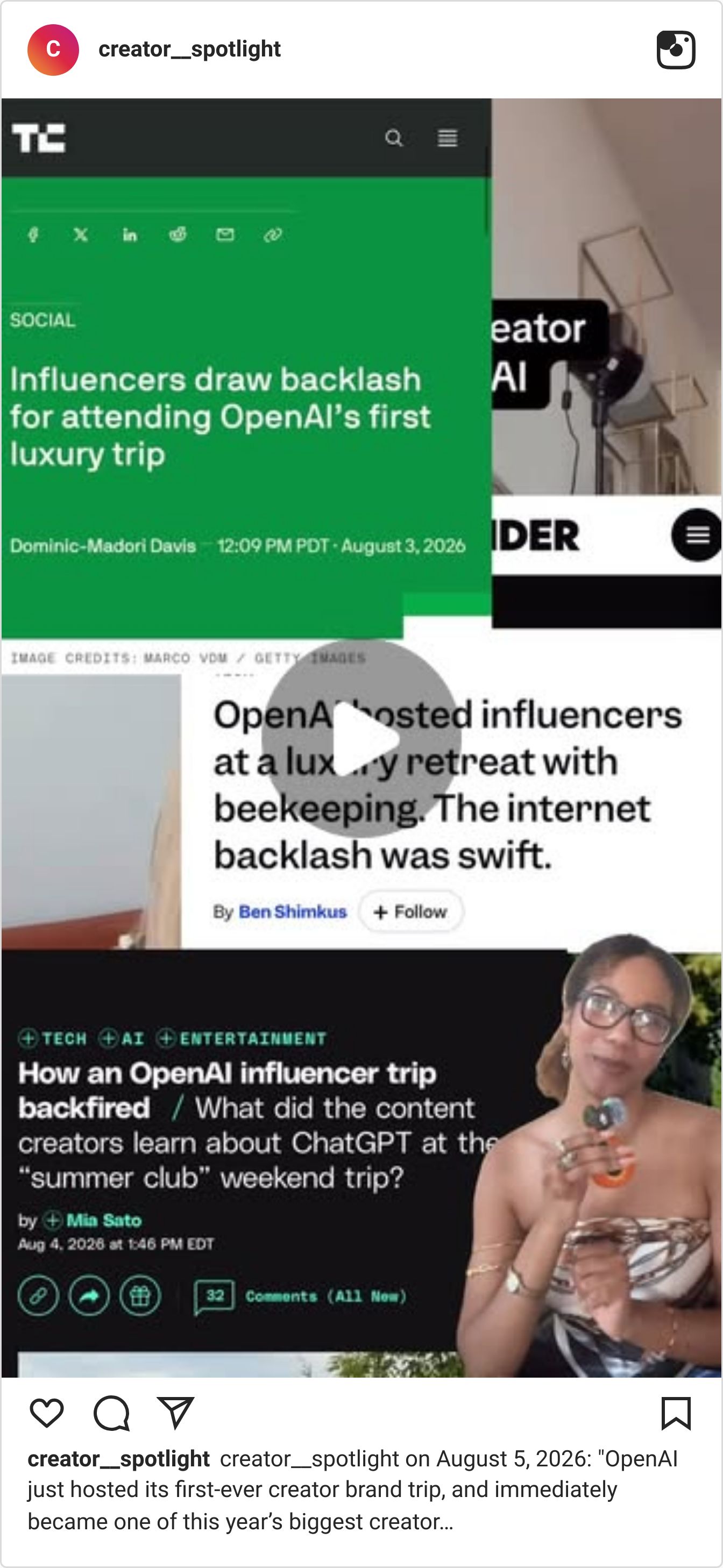
All three of these stories are about a breakdown in trust between audiences and creators, driven by consumer distrust in both the nebulous idea of “AI” and the specific frontier labs. Natalia broke down the spectrum of trust all creators can be mapped against in this newsletter last month.
Barefaced AI content
Reader, I have a confession. I have eaten of the slop.
Earlier this week, scrolling through Instagram Reels, I found myself watching the entirety of what turned out to be the 11th episode of an AI-generated crime drama starring the world’s most famous soccer players. 1.6 million views.
There’s no trust to be broken here. This is clearly, evidently, barefaced AI content.
I shared the video with three separate group chats — “This is insane,” I wrote. I then watched the 12th episode and returned to my day. “I want to unsee that,” one friend wrote back.

This was a @godaresai production. The Instagram account has 89 posts and 511k followers at the time of writing. Social Blade’s tracking data for this page only goes back to March 31 of this year, when the page had 283k followers, but the page’s oldest-available post dates to October 2025.
That first video currently has 15 comments, 2.2k likes, and 119k views. It’s a basic plot — we see an evidently wealthy Lionel Messi hanging out in his pool, on an inflatable orca, while an evidently poor Cristiano Ronaldo cries in his dirty, empty pool. Over the course of the video, Ronaldo mines gold, becomes rich, and builds his own pool. He acquires a live orca; the video ends with Messi clearly distressed and angry, while Ronaldo sits in his pool on the live orca, laughing.
It’s soccer-star fan fiction expressed in the medium of generative AI video.

From that first post, it took seven videos for @godaresai to break 1 million views. Then, from November 17, 2025, to May 23, 2026, the account went on a 45-video run where every video received at least 1 million views.
But the content itself is not the story here. The @godaresai Instagram account has one saved story:

The content plays top-of-funnel for a Skool community.
The link-in-bio takes us to the God Ares AI Academy, with 5.4k members. There is a free option and a $19/month option. Yes, I ponied up the $19. No, I won’t share my referral link. Having paid, I made my way over to the classroom tab to try out one of the lessons. There are six modules:
Getting Started With AI
Creating AI Images
Prompt Vault
Motion Control
Viral Content System
Trend Alerts

I don’t want to give away Marcos’ whole game, but here’s the gist:
Identify a “viral-ready” concept
Identify a case of widely recognizable characters to populate your concept
I do not recommend breaking copyright laws here — creators like this often play fast and loose
Give the concept to ChatGPT; describe the shot you want to generate a still image
Marcos’ course (as well as other vendors’ courses) provide prompt libraries to make this part quite plug-and-play
Use reference images to make sure your characters look consistent from one scene to the next
Feed the still images into Kling AI to turn them into video
Add generated voices and music on top
Export and post
Repeat
It’s an art and a science.
After my lesson, I went to the community tab to see what sorts of conversations the 5.4k members were getting into. The top post, with 3 likes and 2 comments, is from another generative AI course seller. The next-top post is from another course seller.

I don’t know how many $19 payments the God Ares AI Academy has collected besides mine. There are at least 5,400 members, but the most active members are fellow vendors.
And who is @godaresai? Skool lists the name of a community’s creator on the about page — @godaresai is one Marcos Rocha. But his profile picture is a generated picture of Lionel Messi in 300-style Spartan armor, and I could not find any plausible matches across social media and the web.
Back in the classroom modules, there are videos featuring a figure wearing a God Ares AI shirt, framed in a classic YouTuber setting. But he’s clearly generated; it’s in the face, the motions, and the voice — a high-quality generation, but a generation nonetheless.
(I suspected the pages of copy within the classroom modules were also AI, so I threw a few of them into Pangram’s AI detector. Some read as 100% AI-generated, some majority human-written. Sure.)

The @godaresai Instagram account follows 81 people. Scrolling through that list, among famous footballers, I found an indication of Marcos’ identity — a smattering of accounts with Brazilian flags and football teams in their bios, profile pictures showing broccoli-haired Zoomers. Could he be one of them? He’s certainly not the guy in the video still above.
Marcos is only one practitioner of a trend; his identity is not particularly relevant. But all signs suggest he is a Gen Z Brazilian.
Where did he learn to practice this craft, to exploit this trend? The answers lie in his Skool profile, in the six communities of which he is a member:

Looking through these communities, the faceless digital product strategy seems to come from REVENUE REVOLUTION, ostensibly the “Top Skool Community for Faceless Digital Marketing.” The communities Marcos is a member of have a mix of real-person and generated-person creators behind them. The AI Advantage actually has three creators behind it, including noted motivational speaker Tony Robbins.
Of the many thousands of members in these six Skool communities, there are surely plenty of others like “Marcos Rocha” — independent digital laborers using state-of-the-art tools to play the social media algorithms.
The future of AI in the creator economy
In his newsletter covering Hank Green’s AI crisis, Ryan Broderick notes that there’s “one thing generative AI chatbots encourage more than anything else,” which is creating social media content.
It’s worth quoting Ryan at length here:
“Imagine you ran a company that wanted to replace every magazine, newspaper, radio station, TV channel, and movie studio. And imagine you wanted to do that in every country on Earth simultaneously. And imagine you realized you could make a lot more money than those industries ever did if you didn’t pay anyone to make all of that content. But there’s a problem. Your billions of unpaid user-workers, across vastly differently-sized economies around the world, need to keep making content, and that content needs to be just good enough that advertisers don’t complain. So imagine you create a product that those same user-workers have to pay for the privilege of using that constantly pressures them to stay productive, and has all the tools they might need to make passable internet content. Problem solved!
I’d go so far as to say that without social media — or, rather, the need to compulsively post on social media, to be digitally productive — there’d be almost no reason for generative AI to exist at all.”
Marcos Rocha represents the future Ryan describes. And his content may receive millions of views, but if the sentiment this week holds, it’s hard to imagine a public that’s willing to endure platforms entirely populated by AI-generated serial short-form.
The difference between what Marcos is doing and what’s happened in the last couple of weeks with Substack, LinkedIn, Hank Green, and the OpenAI creator trip is that it’s all out in the open. There’s no trust to break; it’s a total embrace of generative AI.
Creatorland leaders Colin Rosenblum and Samir Chaudry, on their podcast this week, discussed the Hank Green scenario in-depth with members of their team. And they arrived at a few principles for using AI in creative work.
What really drew me in, however, was the difference in AI sentiment between the hosts, who are both 37, and their early-twenties employees. The duo spoke about an ingrained millennial understanding that being early adopters of a platform or technology (like AI) can lead to financial and career gains; younger employees were more skeptical.
But what about the Marcoses of the world? I’m assuming he is also in his early twenties, just living somewhere in Brazil instead of Los Angeles.
What’s the difference between people like Marcos and people criticizing Hank Green? On the one side, we’re talking about people trying to find a way to survive and live a dignified life. And on the other side, ditto. The only substantive difference is in how they’re processing these new tools; their understanding of these tools’ ability to improve or degrade their station.
Eventually, the frontier labs and those parties using them to build products will figure out how to package for a wide consumer customer base.
By then, these AI-video-hustle Skool communities will live on only as detritus in the training data. The students criticizing Hank Green today will use versions of these tools in the workplace; a later generation of students will search and sort scholarly papers rapidly and efficiently using new research tools.
And I’ll still be scrolling Instagram or whatever has replaced it, rotting my little brain with content engineered to steal away my time.

