

Brought to you by beehiiv.

This month marks one year since Meta released Edits, their dedicated video editing app.
To learn what the app and its first year can tell us about how the company is currently thinking about creators, I spoke to two people from Meta who’ve been working on Edits:
Justin Antony: Director of Creator Partnerships for North America, across Instagram and Meta’s family of apps.
Jimmy O’ Keefe: Head of Creator Product Marketing across Instagram and Edits.
— Francis Zierer
How AI & MCP servers can empower creators

YouTube owns your audience. open.video gives it back to you — and now AI can run the whole operation. With open.video's MCP server, an AI agent can upload, tag, organize, and analyze your entire video channel from a single prompt. It's your channel, your domain, your data. And now, your AI handles the busywork.
→ Own your channel at open.video
This is an advertisement.
One year of Edits

On January 19, 2025, every ByteDance product (TikTok, CapCut, Lemon8) vanished from U.S. app stores overnight. The ban lasted less than a day, but for creators, it was long enough to expose the business risk of relying too much on too few tools and platforms.
That same day, Meta announced Edits, its first standalone creative production tool, a video editing app built for creators.
For the user, Edits functions as an analytics and video editing tool; for Meta, it’s a creator-professionalization accelerator. It’s designed to catch creators at the moment of transition from casual user to serious producer.
In this light, Edits is the most significant bet Meta has made on creators to date. By at least one metric, it’s working; this March, Scalable reported that 10% of daily Reels viewed in Q4 2025 were created with Edits, nearly triple the previous quarter’s share.
An increase in professionalized creators working in the Meta ecosystem benefits the creator ecosystem as a whole. Of course, this also means more and better content on Instagram; more consumer time in-app; more ad revenue for Meta.
Justin Antony, Director of Creator Partnerships for North America at Meta, frames his work around this alignment.
"My KPI, I always say, is how many people can I make millionaires by using these platforms? I love finding someone that's at 9,000 [followers], just starting, and then seeing them a couple years later at four million. It's just life-changing for them."
For most of Instagram's history, creators were the platform's third audience. Consumers came first, advertisers came second.
This tracks; Instagram, founded in 2010, was originally an app for connecting with friends.
The algorithmic feed was rolled out for Instagram in 2016, and the Reels feature was released in 2020. These two changes cemented Instagram as a creator platform. The infinite scroll of Reels, combined with the algorithm's powerful distribution system, accelerated the growth of Instagram’s creator ecosystem.
Edits is unique among Meta’s offerings:
It’s not a social app. It is purely a production tool. Previously, the company’s production tools were less powerful than dedicated offerings and were available only within their social apps.
It’s a startup within the larger Meta organization.
Combined, these two traits mean product development is less complicated, can move quicker, and is more creator-oriented than with a product like Instagram.
“Over the years, we've tried to make our in-Instagram-app, first-party creation toolkit, something that would work for lots of different types of short-form video creation, because Instagram is trying to be 10 things before it is trying to be a short-form video editor.”

Core editing functions are table stakes, but …
Long before they launched the app, Jimmy O’ Keefe, Instagram’s Head of Creator Product Marketing, told me they made sure to integrate creators into the product development process.
“Sitting in the room with our team, helping us with designs, giving us feedback throughout, partnering with us to make effects. We're not talking about big professional creators, necessarily. It's anybody who's starting to get a little bit serious about content creation.”
He acknowledged that for Edits, the core editing functions — removing backgrounds from talking heads, adding audio effects, all the basic tools of the trade — are table stakes. ByteDance’s CapCut (among other tools) has had these features for years.
Creators who switch to Edits do so to take advantage of the app’s integration with Instagram and, in doing so, to better serve and grow their audience on Meta’s platform.
Jimmy described two main things creators using Edits tend to say they like most about the tool:
The first is Edits’ ability to support the creative process end to end: ideation, workshopping, production, and posting to whichever platform you choose.
The second is, of course, Edits’ integration with Instagram.
“Edits is meant to be an app that is best on Instagram, but can work across any platform. But we have been working on a couple of integrations with Instagram that other apps can't do.
For instance, this new links feature that we launched, which allows creators to pull from the entire Instagram library of content, whether it's Reels or other posts, and link to them in their content.”
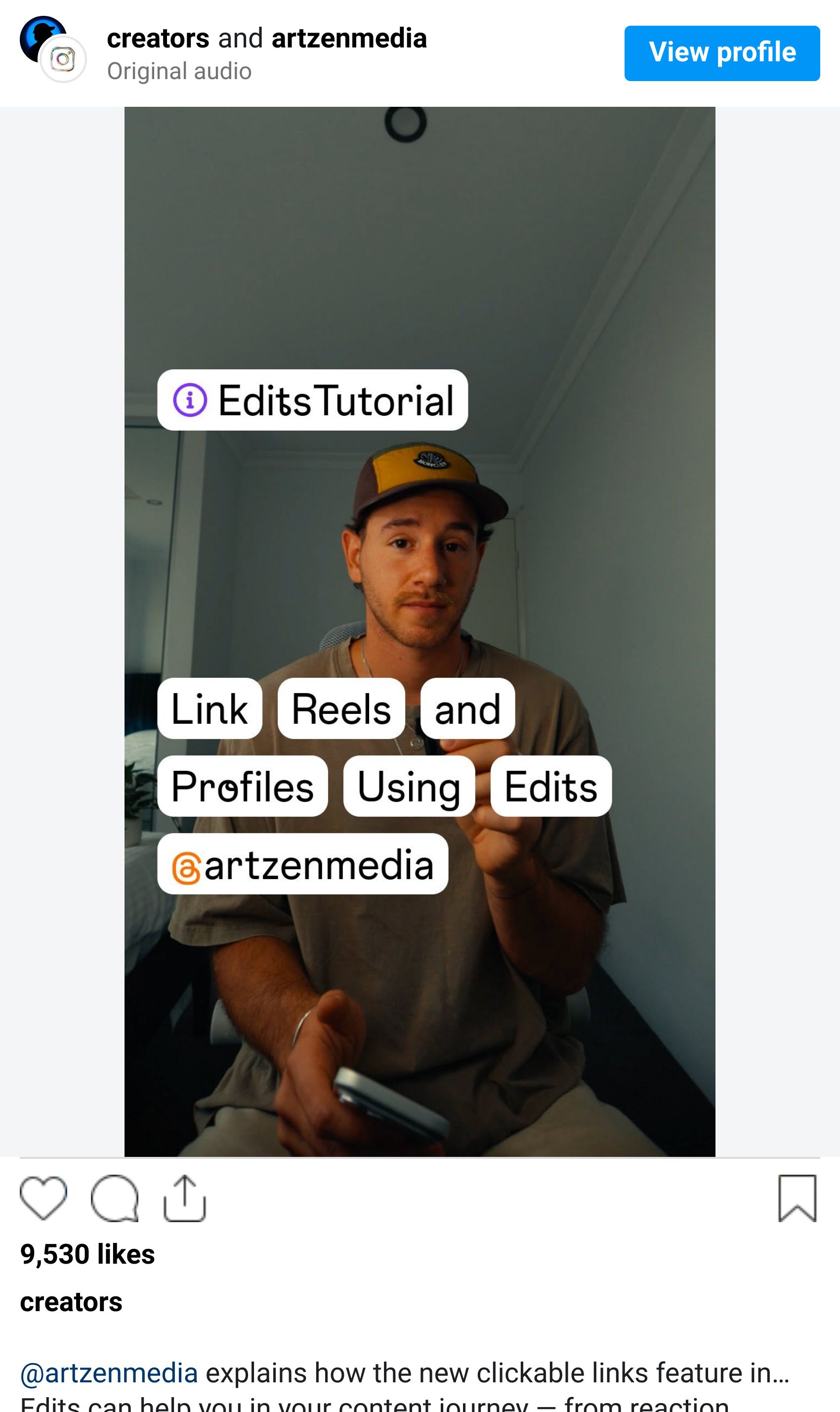
Both of these points are expressed in the Ideas tab, which immediately stands out as unique among video editing tools.
The Ideas tab pulls your saved Instagram Reels into a workspace and surfaces their analytics (save rate, share rate). This encourages users to save Reels not for their personal interest (e.g., a recipe they want to cook or a workout routine they want to do), but for the components worth mimicking.
Without Edits, Justin pointed out, creators would need to track this work manually.
“They would open up their phone and go to the notes, and they'd have notes all over. And then they're like, but this one's for this note, this one's this idea. And it was so disorganized, and some people actually texted themselves."
Additionally, users can view advanced analytics for their existing Reels and — in a previously unavailable option — embed linked Reels from across Instagram into new Reels.
While CapCut doesn’t have a feature like this, other tools are being built for the cataloging-and-studying part of the short-form video workflow.
Earlier this year, we interviewed Kane Kallaway, whose platform, Sandcastles, enables users to search for videos across TikTok, Instagram, and YouTube, identify performance outliers, and use AI to extract hooks and story structures, which they can save as templates and adapt for their own scripts.

Watch Kallaway explain Sandcastles
Edits’ tooling is not yet as advanced as Sandcastles and is limited to Instagram. But it’s also free; Kallaway’s app starts at $49/month. The goal is to make the app as accessible as possible for as long as possible. Again, the core benefit for Meta here is an increase in skilled creators publishing in the Meta ecosystem; Edits does not need to make money so directly.
Eventually, they may charge for certain features — AI-enabled features that carry a high token cost, as Sandcastles does — but they aim to keep “the core tools” that make Edits work for creators free forever.
“The value that we see Edits having for Meta is not like the revenue that will be generated from charging for premium features.
Ultimately, we hope that if Edits is a tool that creators like and it helps them make better content, then it can help create more and better content for Instagram, which would strengthen the Instagram ecosystem. That's really what it's about.”
CapCut and other competitors started with a more developed feature set, but Edits has quickly caught up; it’s the native Instagram integration that will win market share in the long run.
